


Is Your Home Ready For a Winter Storm?

As I write this, the next "generational" ice storm is on its way to Georgia and I want to make sure you, the homeowner, are ready. One of the most common issues resulting from a big freeze, especially in Georgia, is burst pipes, causing major water damage throughout the house. Let's talk about why that happens and how to prevent it.
Why do pipes burst? (Hint: it's not just the ice)
We all know that water expands as it freezes, but what you might not know is that pipes rarely burst where the water freezes. The water in your home is always under pressure. When an "ice plug" forms in a pipe, it traps the water between the ice and your fixture. As the ice grows, the pressure builds, sometimes 10-20x as high as your pipes are rated for, until the pipe finally "unzips." Your outdoor faucets (hose bibs) are usually the weak link because they act like a highway for heat to escape your home.


What about hose bib covers?
There are two main types of covers you can install over your hose bibs: the foam dome and a fabric sleeve. These covers seal the fixtures off from the outside air and rely on their insulating property to keep them from freezing. I wanted to see if one was better than another, so last year I did an informal study on my own home to see.
Before I describe it, I want to start by saying this was not a true scientific experiment and I would set this up differently if I did it again, but I think the results are still good enough to interpret for our purposes.
I placed identical temperature sensors inside two different hose bib covers: a fabric sleeve cover for the HB on the front of my house (South facing wall, close to the adjacent house) and a foam dome on the rear HB (North facing). Then I let those sensors monitor each location for about a week during a cold snap. Here are the results (blue line is outdoor temperature, red line is the temperature inside the front HB with the fabric sleeve, yellow line is the rear hose bib air temperature inside the foam dome). Temperature (Farenheit) on the Y-axis and time (1 day) on the X-axis.
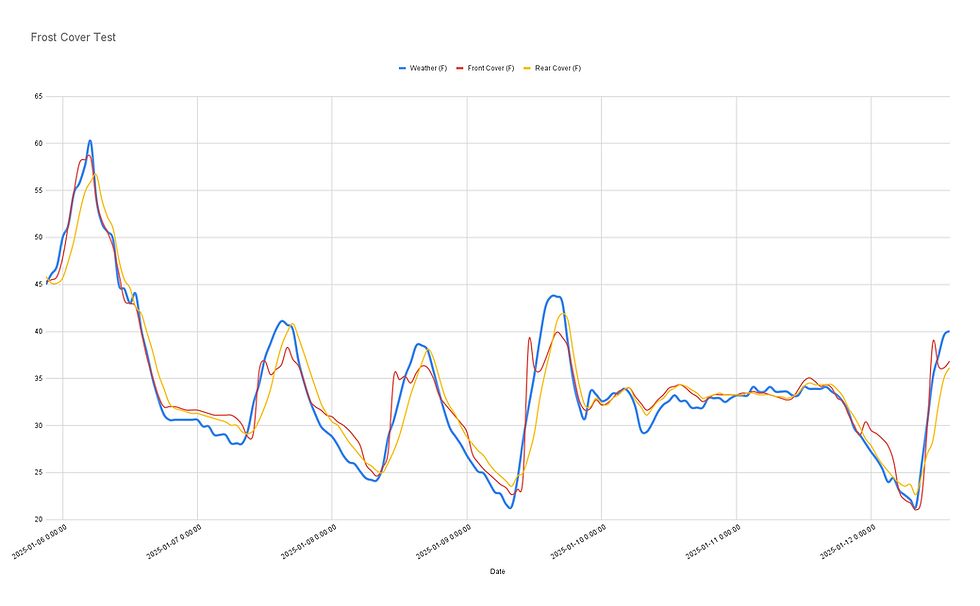
Again, the test has some major flaws in it, but it still shows us a couple of things:
Neither cover is great at keeping the air inside the cover from dropping below freezing.
The foam dome seems to work slightly better, but even that basically saves you 1 degree with about a 2 hour lag behind the outside temperature.
This tells me that hose bib covers are not a great solution on their own for preventing freezing pipes.
Why don't they work?
Both of these HB covers rely on slowing down heat transfer from the water in your pipes to the outside air. To emphasize, they don't stop heat transfer, they slow it down. Like the inside of your walls, these covers have an insulation R-value, which is the measure of how quickly heat moves through an object. The higher the R-value, the slower heat moves through it. So with these covers on, if no other outside forces are acting on your pipes, they would still freeze, just slower than the outside air freezes. However, many houses' pipes don't freeze because the heat warming your home is also warming the pipes from the inside, acting like a tug of war between that heat and the colder outside air.
These covers will also trap a little bit of heat inside them, either from air leakage through the exterior wall or conductively through the pipes or wall. Ironically, the better the house is built, the worse it will protect your pipes from bursting; high performance homes leak very little air and have far less heat transfer through their walls. So an old, leaky house might work better with a hose bib cover than a new, efficient one.
Overall, I wouldn't rely solely on these covers to keep your pipes from bursting in an extended freezing event.
What is the solution?
How your house is set up will determine the correct approach for you.
Step One
No matter what approach you take, you need to disconnect your garden hoses from all hose bibs (and drain the hoses).
Best
The best and easiest solution is to have frost-proof hose bibs installed in your home. These are a standard practice in colder climates. Frost-proof hose bibs will shut off the water inside the wall, instead of outside at the fixture itself, and drain any remaining water in the line. That action brings all of the water back into the conditioned space and gives you nothing else to do during a freeze.


Better
Since 2001, Georgia code has required a separate shut-off valve for outdoor faucets. They're typically under a sink, in a mechanical room, or in a crawlspace.
Close the interior valve (handle should be perpendicular to the pipe).
Go outside and open the hose bib to drain the remaining water.
Good
If you don't have the options above, use a cover, but don't stop there. Drip your faucets; moving water is much harder to freeze.
Rule of Thumb: If it's under 20°F outside, open the cabinets under your sinks. This lets the warm air from your kitchen reach the pipes hidden behind the doors.
At New South Homes, we don't just build houses; we teach you how to care for them so they last for generations. Taking ten minutes to prep your hose bibs today can save you thousands of dollars and countless headaches next week.
Not sure if your home is winter-ready? Send us a photo of your hose bib on Instagram and we'll tell you which category you fall into.


Comments